
Tag: Sovereignity

  • Microsoft Cloud for Sovereignty

    Microsoft Cloud for Sovereignty


    Microsoft Cloud for Sovereignty

    How much control do you need?


    Let me start with a small confession:

    I’m not particularly well-organized. At least that’s how it feels to me most of the time. This becomes especially apparent right before I’m heading off for vacation — like right now, as I’m preparing to leave this afternoon for a well-deserved Easter family vacation. 🐣

    Two weeks of no work emails, no Teams calls, and (hopefully!) no sudden escalations. That’s the goal anyway. But as anyone who’s been in my shoes knows, taking time off isn’t just about setting an out-of-office message and walking away. There’s a whole process that needs to happen behind the scenes. For me, the last days before a break are usually packed — making sure everything is updated, tasks are clear, responsibilities are properly delegated, and nothing critical gets stuck during my absence.

    And yes, that means these last couple of days at work get noticeably longer — and the coffee consumption inevitably higher. ☕😅

    Honestly, I’m still searching for the perfect formula here. What’s your experience? Do you have a secret best practice to optimize things before you leave for a vacation? I’d love to hear how you handle it — share your insights in the comments below!


    Speaking of control — let’s talk about Data Sovereignty again!


    On February 3rd, I shared a post here titled EU Data Boundary — Microsoft’s Next Big Step for European Data Sovereignty here.

    Back in February, I talked about the concept of the EU Data Boundary for Microsoft Azure and Microsoft 365, focusing mainly on the challenges and opportunities organizations face with data residency and sovereignty within the EU. But when we discuss controlling data, especially sensitive or mission-critical data, there’s actually even more on the menu from Microsoft than you might realize.

    So today, let’s take a deeper dive into Microsoft’s broader Digital Sovereignty Portfolio and unpack your options:


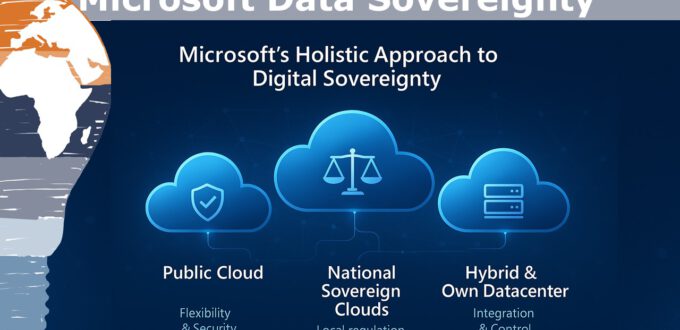
    Microsoft’s Four Flavors of Cloud Control


    Microsoft offers different flavors of cloud solutions, each tailored for specific business needs regarding control and sovereignty over your data:

    1️⃣ Microsoft Public Cloud (Azure)

    This is the go-to, standard version most businesses rely on. It provides global scalability, comprehensive features, robust security, and compliance certifications right out of the box. For most workloads, it’s the ideal balance between flexibility, cost-efficiency, and convenience.

    If your workloads aren’t subject to very restrictive data sovereignty or compliance rules, this is usually your best choice.

    2️⃣ Microsoft Cloud for Sovereignty

    This version steps up the game, especially designed for organizations needing more stringent data protection and compliance. Microsoft Cloud for Sovereignty allows you to manage your own encryption keys fully, meaning you retain absolute control over your data security. This solution is tailored specifically for governments, regulated industries, and clients that operate under strict security and sovereignty standards.

    If you absolutely must hold the keys (literally!) and need an enhanced layer of control, this version fits perfectly.

    3️⃣Sovereign Clouds with Microsoft Technology (Bleu, Delos)

    Starting in 2026, Europe will see the launch of two major sovereign cloud initiatives powered by Microsoft technology:

    • Bleu in France 🇫🇷
    • Delos in Germany 🇩🇪

    These clouds will be operated locally by trusted partners, ensuring full compliance with national regulations and the highest possible standards of digital sovereignty and data privacy. This setup ensures data stays completely within the country and under local jurisdiction, while still benefiting from proven Microsoft technology.

    Important: Both Bleu and Delos clouds are specifically designed for government entities and companies closely affiliated or tied to governmental operations. If you belong to these groups, these solutions provide an unmatched combination of national sovereignty and technological excellence.

    If your organization faces especially rigorous national data protection requirements and governmental affiliation, these localized clouds will be your safest bet.

    4️⃣ Azure Local – (Previously Azure Stack Hub, now on any hardware)

    Azure Local takes it even further. It provides Microsoft Azure cloud capabilities deployed directly on-premises, inside your own data center, using practically any hardware you prefer. This is an evolution beyond Azure Stack Hub, offering far greater flexibility. It gives you complete physical and digital control, as the cloud infrastructure runs under your own roof.

    If your workloads require total isolation, compliance under extremely restrictive conditions, or you simply prefer the physical proximity and direct control, Azure Local is your ideal solution.


    Choosing the Right Level of Control — What’s Best for You?


    Data sovereignty isn’t a one-size-fits-all scenario. Your organization’s ideal solution depends on multiple factors, including regulatory requirements, industry standards, compliance needs, your own security policies, and frankly, your comfort level. The good news is: Microsoft provides choices that match virtually every scenario.

    Reflecting on these choices, it becomes clear that data sovereignty isn’t just about technology — it’s about strategic alignment with your business, governance, and risk management goals. Having the right level of control gives you the confidence and flexibility to innovate safely, securely, and efficiently.

    Learn more about Microsofts Cloud for Sovereignty here.


    Wrapping Up


    Control & Sovereignty Matters! Whether you’re packing your bags for a vacation (like I am right now 🧳) or determining the right strategy for managing your critical data assets — preparation, clarity, and a clear understanding of the level of control you actually need are key to your peace of mind.

    To circle back — let me know how you handle your preparation before you unplug for a break. And if you’d like to discuss any of these cloud sovereignty topics in more detail, just reach out or drop a comment below. I’m always happy to dive deeper into these fascinating topics!

    Wishing you relaxing breaks, secure data, and the perfect level of control — whatever that means for you! 😉

    Stay awesome!

    Your Mr. Microsoft

  • Microsoft EU Data Boundary

    Microsoft EU Data Boundary


    Microsoft’s Next Big Step

    for European Data Sovereignty 🏢🌐


    Hello everyone, and welcome to my latest deep dive on the evolving landscape of data protection in Europe. As someone who studied Business Administration at the Christian-Albrechts-Universität (CAU) Kiel, I’ve always been fascinated by the intersection of global tech services and local regulatory requirements. So let’s have a look into Microsoft EU Data Boundary.

    Amid ongoing inflation, supply chain challenges, and heightened geopolitical tensions, from the war in Ukraine to rising US & China competition, businesses across the EU, especially in Germany, face an unpredictable economic and political landscape. This climate increases the urgency for secure, compliant, and resilient IT infrastructures that can weather any storm. A single security breach or compliance lapse can now spark serious legal, financial, and reputational fallout. Consequently, robust IT environments have shifted from a strategic advantage to a fundamental requirement for sustaining trust and growth. And through the uncertainties and the unpredictable political decisions from President Trump, this is going even further.

    Today’s spotlight is on Microsoft’s EU Data Boundary initiative — a development that could significantly affect how enterprises in Germany handle their data in the cloud.


    What Is the EU Data Boundary Initiative?


    In 2024, Microsoft unveiled additional measures under its EU Data Boundary framework, promising that certain customer data for core services such as AzureMicrosoft 365, and Dynamics 365 will remain strictly within the European Union. The overarching goal is to give customers in the EU, especially in Germany, greater confidence that their data is not being transferred outside the region in ways that might conflict with local privacy standards.

    Essentially: Microsoft is bolstering its existing data center infrastructure and implementing new technical and operational controls to ensure that data tied to these services stays within the EU. The initiative covers identity and metadata, as well as other categories of customer data, reflecting an end-to-end approach to data sovereignty.

    Sources for further reading:

    Why Does This Matter for Enterprises in Germany?

    1. Heightened Regulatory Expectations
    German businesses face rigorous data protection requirements, with GDPR being just the starting point. Cloud services that can demonstrate alignment with EU data localization standards are better positioned to address regulators’ concerns and customers’ privacy expectations.

    2. Strategic Confidence
    Enterprises want to harness the full power of the cloud without anxiety over whether their data might be pulled across borders. Whether that’s running advanced analytics on Azure or leveraging collaboration tools within Microsoft 365. An explicit boundary fosters trust, streamlines procurement decisions, and underscores a commitment to local data stewardship.

    3. Competitive Edge
    Many industries, particularly finance, healthcare, and public sector, place data sovereignty at the forefront. Having a clear EU Data Boundary gives Microsoft’s services a strong selling point, potentially outpacing competitors that lack similar commitments. For businesses themselves, aligning with a trusted cloud provider can differentiate them in the marketplace.


    Key Components of the EU Data Boundary Effort


    From what we know, Microsoft’s plan extends beyond mere data center location. Here are some main elements that enterprises should pay attention to:

    1. Data Residency & Control
      Microsoft is investing in localized data center regions, enhancing the infrastructure that keeps core customer data, including identity and diagnostic logs, within EU boundaries. These initiatives tie in with existing data residency options that Microsoft has offered in Germany and other European countries.
    2. Technical Safeguards
      Beyond physical location, technical solutions — like encryption at rest and in transit — help ensure that even if data is accessed outside the EU for support or troubleshooting, it remains protected. Where feasible, Microsoft is reducing the scenarios in which data would leave the EU for routine operations.
    3. Compliance and Transparency
      Microsoft’s Trust Center and related documentation detail how the EU Data Boundary aligns with GDPR requirements. By offering auditing tools, clear documentation, and robust data governance features, Microsoft aims to simplify compliance processes for its customers.

    Practical Insights for Businesses and IT Teams


    Now that we’ve established the basics, let’s talk strategy. If you’re an IT decision-maker in Germany, or anywhere in the EU, here’s how you can leverage Microsoft’s EU Data Boundary:

    • Revisit Your Cloud Architecture
      Evaluate where you store sensitive or regulated data. If you already use Azure or other Microsoft services, see how your current architecture might be refined to maximize data residency within EU data centers.
    • Check Licensing and SKUs
      Some advanced data residency features or region-specific controls may require particular service plans. Make sure you select the right license or SKU to take full advantage of localized data processing.
    • Engage Stakeholders Early
      Loop in your legal, compliance, and security teams to validate that your chosen cloud setup meets internal policies and external regulations. The earlier these discussions happen, the fewer issues you’ll face down the line.
    • Stay Informed
      As this initiative evolves, keep an eye on Microsoft’s documentation. They may expand the scope of data categories included or roll out updates to address new regulatory requirements.

    Shaping a New Era of Cloud Trust


    From a broader perspective, Microsoft’s EU Data Boundary highlights how major cloud providers are navigating an era of heightened data localization demands. Ten years back, cloud discussions often revolved around cost savings and scalability. Fast-forward to the current environment, and we see data sovereignty, privacy, and compliance at the forefront.

    This shift speaks to the power dynamic between global cloud providers and regional authorities. As governments push for stricter data residency rules, providers are adapting by forging deeper local commitments — whether that’s building data centers, adopting robust encryption practices, or fine-tuning how data flows under the hood.

    Looking ahead: If Microsoft’s approach proves successful, we might witness similar initiatives from other big players, each competing to assure customers they can keep data within Europe. Businesses, in turn, can focus more on innovation and less on worrying about data traveling across jurisdictions.


    Your Next Steps


    Curious about whether your organization can benefit from Microsoft’s evolving EU Data Boundary? Here’s what to do:

    1. Assess Current Cloud Use: Identify which workloads or data sets are most sensitive and check if they’re already in a suitable Microsoft data region.
    2. Consult the Official Resources: Head to the Microsoft Trust Center and the Microsoft Learn: EU Data Boundary pages for the latest details.
    3. Engage Experts: Work with your compliance officers and cloud architects to map out a path to full alignment with your local data protection requirements. Engage experts from major Business Transformation consulting companies.
    4. Evolve Over Time: As Microsoft continues to refine this initiative, keep revisiting your architecture to incorporate new features or enhancements.

    Final Thoughts


    Whether you’re a large enterprise grappling with cross-border data flows or a mid-sized company seeking greater certainty in a complex regulatory landscape, Microsoft’s EU Data Boundary offers a compelling roadmap. It aligns with an era where data privacy stands as a top priority, ensuring that the cloud can remain a powerful engine for innovation without compromising compliance needs.

    Has your organization taken advantage of localized data residency options yet? Feel free to share your experiences or drop any questions you might have in the comments below. Let’s explore how these developments can reshape the cloud strategies of German and European businesses, forging stronger trust in the process.

    Read more about Cloud here in my Blog