
Tag: Storage

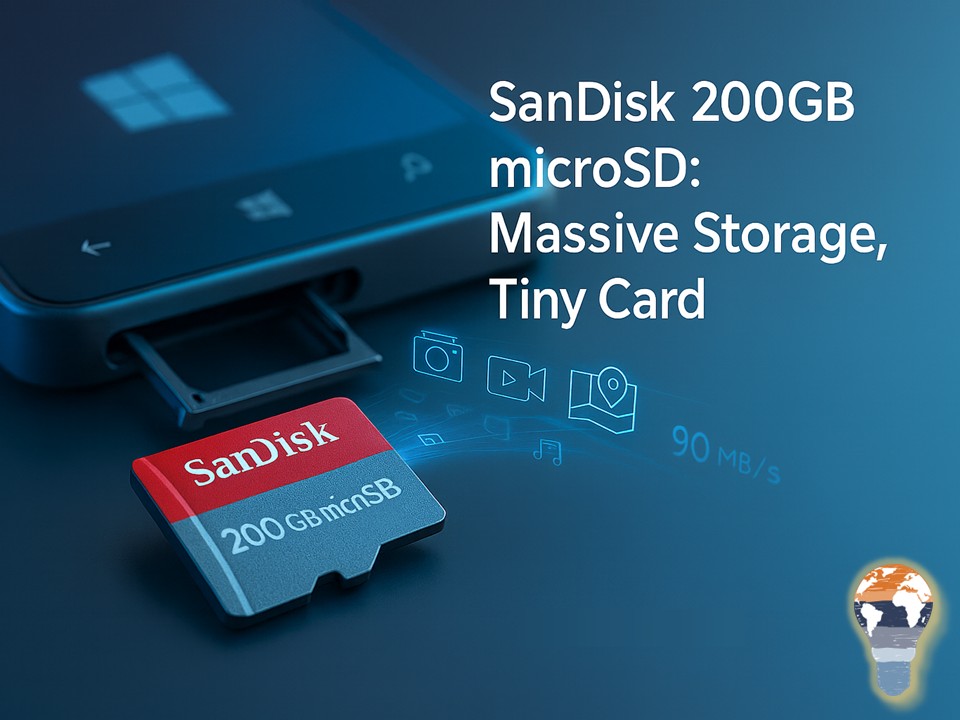
  • SanDisk’s 200GB microSD: Massive Storage, Tiny Card

    SanDisk’s 200GB microSD: Massive Storage, Tiny Card


    SanDisk’s 200GB microSD:
    Massive Storage, Tiny Card


    Remember when 32 GB felt roomy? Now, SanDisk just blew past “roomy” and landed squarely on “whoa.” The company unveiled a 200 GB microSD card—at launch the world’s highest-capacity microSD—and yes, it fits under your thumbnail. Availability is slated for Q2 2015 with an MSRP around $399.99 and rated read speeds up to 90 MB/s. That’s roughly 1,200 photos per minute shuttling from card to PC under ideal conditions. Not bad for something the size of a fingernail.


    Why It Matters If You’re In The Microsoft/Windows Ecosystem


    For Lumia users (640/640 XL, 830, 930, 1520) or anyone with a microSD-friendly 2-in-1, this tiny card behaves like a digital attic in your pocket. It changes how you capture, carry, and work with content when you’re offline or on shaky hotel Wi-Fi.

    What that looks like in practice:

    • Whole music libraries, offline maps for entire regions, and hours of 1080p footage—without storage anxiety.
    • Field teams capturing photos and video all day, then syncing to OneDrive when back on a solid connection.
    • Travelers ditching the “what do I delete?” routine on long trips.

    Specs Snapshot


    Specs set expectations and help you decide whether to jump early or wait for prices to settle. This is what SanDisk claimed at launch:

    • Capacity: 200 GB (microSDXC, UHS-I, Class 10)
    • Rated speed: Up to 90 MB/s read
    • Launch window: Q2 2015
    • MSRP: ~USD 399.99
    • Warranty: Up to 10-year limited (region dependent)
    San_Disk 200GB MicroSD Card

    Compatibility And Setup Essentials


    Before you buy, make sure your devices are ready. A quick compatibility check and a clean setup will save you headaches later.

    Key points to verify:

    • Device support: Your phone, tablet, camera, or 2-in-1 must support microSDXC (exFAT).
    • File system: Format in exFAT for files over 4 GB (useful for long 1080p clips).
    • App installs: Windows Phone 8.1 lets you move apps/games to SD, but media (photos/video/maps) benefits most.
    • Controller realities: “Up to 90 MB/s” is peak read; write speeds depend on the workload and device controller.

    How More Capacity Changes Your Behavior


    Big jumps in storage unlock new habits. When capacity stops being a constraint, you capture more, delete less, and treat your phone as a first-class camera and recorder. That’s not just convenience; it’s workflow. Creators record full interviews instead of snippets. Field technicians document entire sites instead of highlights. And commuters keep full playlists and video libraries offline for those no-signal moments.


    Real-World Uses That Shine


    Different roles benefit in different ways, but the common thread is uninterrupted capture and confident offline work.

    Examples worth calling out:

    • Mobile content studios shooting 1080p all week without nightly offloads.
    • Pro workflows with Office mobile + OneDrive and a large local cache to avoid sketchy conference Wi-Fi.
    • Windows devices in the field capturing site photos, inspection videos, and scanned docs without playing musical chairs with storage.

    Nerd Notes: File Sizes, Bitrates, And Headroom


    A bit of math helps you plan. With 200 GB, many common scenarios become “set it and forget it” rather than “constantly juggle files.”

    Rules of thumb:

    • 1080p video at ~20 Mbps consumes about 9 GB per hour—so 20+ hours before you need to offload.
    • RAW photos at ~25 MB each translate to roughly 8,000 shots.
    • Offline map data can land in the double-digit gigabytes; with 200 GB you simply download entire regions.

    Care, Authenticity, And Performance Tips


    Good habits protect performance and your data. A couple of simple checks up front go a long way.

    Practical hints:

    • Buy from reputable retailers; counterfeit cards are a thing.
    • Validate capacity/throughput on first use (Windows tools or third-party utilities).
    • Format in-device after first insert so controllers optimize allocation.
    • Keep a backup routine: removable ≠ invincible—sync to OneDrive or your NAS on good Wi-Fi.

    microSD And Cloud In 2015: Use Both


    Cloud is brilliant for backup, sharing, and collaboration, but local storage wins when you’re offline or capturing continuously. The smart setup is both: record locally to a fast, spacious microSD; then sync to OneDrive when you hit reliable connectivity. In 2015, that combo delivers resilience, speed, and peace of mind.


    Bottom Line


    In 2015, 200 GB on microSD isn’t just a spec bump—it’s a behavior shift. If your device supports microSDXC and your work or life is heavy on photos, video, music, and offline content, this card turns storage anxiety into a distant memory. Pricey at launch? Absolutely. But for creators, travelers, and power users, it’s a premium that pays in fewer “storage full” pop-ups and more moments captured without compromise.

    Stay clever. Stay responsible. Stay scalable.
    Your Mr. Microsoft,
    Uwe Zabel


    🚀 Curious how mobile and Microsoft go hand in hand?
    Follow my journey on zabu.cloud—where cloud, AI, and business strategy converge.
    Or ping me directly—because building the future works better as a team.

  • Apple Adds Clearer View of Your iCloud Storage

    Apple Adds Clearer View of Your iCloud Storage


    Apple Adds Clearer View of Your iCloud Storage


    If you haven’t visited iCloud.com in a while, you might be surprised to see how Apple has refined the Settings section. Beyond the usual file management and “Find My iPhone” options, Apple now provides a more intuitive overview of your online storage usage, including how your (often too limited) iCloud space is divided among photos, backups, documents, and apps. The new storage bar will feel familiar if you’ve seen Apple’s iTunes storage indicators for iOS devices, making it quick and simple to spot what’s gobbling up your cloud quota. 


    More Transparent Storage Management 


    For years, iCloud has been the behind-the-scenes engine syncing your photos, documents, app data, and device backups. But if you’re like me, you occasionally bump into that dreaded “Your iCloud Storage is Almost Full” notification. Now, on iCloud.com > Settings, you can see at a glance: 

    1. Visual Storage Bar: A color-coded bar that highlights photos, backups, and documents in distinct shades — just like when you connect an iPhone to iTunes. 
    1. Detailed Device List: Below or alongside the bar, you’ll spot every device currently signed in with your Apple ID, from iPhones to iPads to Macs. No more poking around multiple menus to check which old iPad is still hogging backup space. 

    It’s a minor tweak, but one that makes iCloud’s usage far less mysterious. Instead of guessing which app is chewing up all your gigabytes, the layout offers a quick way to identify whether it’s your photo library, iOS backups, or something else entirely. 


    Device Management: More Transparency on Linked Hardware 


    Alongside the improved storage display, the revised iCloud Settings page also details which devices are signed into your Apple account. For instance, you’ll see a neat list of all iPhones, iPads, and Macs that are currently associated with your Apple ID. From here, you can verify whether some long-lost device is still registered or remove a gadget you no longer use. This is particularly helpful if: 

    • You replaced an older iPhone but never officially removed it from iCloud. 
    • You suspect your Apple ID might still be signed in on a device you sold or gave away. 

    In a time when security threats are increasingly common, having a straightforward way to see where your Apple ID is logged in is a welcome addition — especially for anyone who’s hopped between multiple Apple devices over the years. 

    New iCloud device management

    Why Does This Matter? 


    1. Simplified Cloud Awareness: Many of us have minimal patience for digging through countless menus just to see why our iCloud is full. The new layout addresses that by highlighting usage in a single snapshot, encouraging people to manage data before hitting capacity. 
    2. Better Cross-Device Sync: With Apple increasingly tying everything — photos, documents, health data — across iPhones, iPads, and Macs, iCloud is the linchpin. Being able to monitor which devices are active helps keep your account tidy and secure. 
    3. Competition with Other Cloud Services: Apple is often critiqued for offering meager free storage compared to Google Drive or OneDrive. While the new interface doesn’t fix that outright, it does show Apple is paying attention to user experience for iCloud’s paid and free tiers. 


    Expanding iCloud Storage: Is It Worth It? 


    Given iCloud’s 5 GB free tier feels cramped for most active iPhone users, Apple might hope these visual cues nudge you into a paid plan. In 2015, Apple offers: 

    • $0.99/month for 20 GB 
    • $3.99/month for 200 GB 
    • Higher tiers for heavier users (500 GB, 1 TB, etc.) 

    If you rely on iCloud for backups, photos, or iCloud Drive documents, the new layout might remind you that you’re running out of space. Upgrading could be the simplest solution — unless you prefer juggling multiple services like Dropbox or Google Photos. Apple’s streamlined interface could sway some users into consolidating with iCloud for everything. 

    Nerdier Details (Just Because) 

    • Storage Graph: The color-coded usage bar is dynamic, updating whenever you remove a device backup or purge old documents from iCloud Drive. 
    • Data Categories: iCloud lumps certain apps or system data together, so you might not see each app singled out. If you want more granular detail, you’ll still need to check iOS’s “Manage Storage” menus on your iPhone or iPad. 
    • Device Footprint: Tapping a device in the list can show how much space its backup is claiming. Useful for pruning, say, a 10 GB backup from an old iPad. 

    Bottom Line: A Step in the Right Direction 


    While Apple’s iCloud storage expansions and improvements continue to evolve, iCloud.com’s revised Settings page feels like a breath of fresh air for anyone tired of cryptic usage pop-ups. Even though iCloud is not yet the most generous or the most flexible cloud solution out there, these little interface tweaks give us hope that Apple is listening to user feedback, at least when it comes to clarity and management of precious cloud space. 

    Have you checked out the new layout on iCloud.com? Feel free to share your experiences or tips in the comments below. Let’s see if Apple’s next moves on the iCloud front — like rumored photo management upgrades or pricing tweaks — keep pushing usability forward for 2015 and beyond. 

    #iCloud #Apple #Storage #CloudServices #iCloudDrive #DeviceManagement #ZabuCloud #2015Tech