
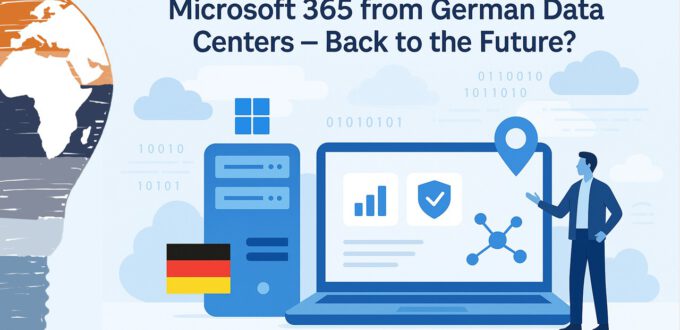
Microsoft 365 from German Data Centers – Back to the Future?
Do you remember 2016? Pokémon Go had us wandering through parks, Stranger Things hit Netflix for the first time, and Microsoft launched its very own sovereign cloud in Germany, complete with data trustee and physical isolation. Well, guess what? We’re back. Sort of. Because Microsoft 365 is now—once again—available from German data centers.
But let me tell you upfront: it’s not a reboot, and it’s definitely not a sequel. It’s more like the remastered director’s cut, with extra features and better performance, but also a new plot twist.
Let’s hit rewind for a moment.
The First Chapter: Microsoft Cloud Germany and the Data Trustee Model
In 2016, Microsoft did something truly bold. In response to the Safe Harbor ruling by the European Court of Justice (which left many companies scrambling for a legally sound data hosting strategy), Microsoft introduced a German sovereign cloud hosted by T-Systems, with a very special setup:
- The data was hosted physically in Germany.
- T-Systems acted as a data trustee, controlling access.
- Microsoft, despite being the provider, couldn’t access your data—even if they wanted to.
- It was isolated from the global Microsoft backbone, meaning no traffic left Germany unless explicitly allowed.
Sounds like a nerd’s dream of digital sovereignty, right? 🛡️
Well… almost. The model was secure, yes. But it came at a price. Both literally (about 25% more expensive than standard cloud) and functionally. The isolation meant limited feature sets, slower innovation, and no global integrations.
Microsoft’s own statement sums it up:
In the last three years, customer requirements have changed. Our customers want more comprehensive functionalities and connectivity with our global cloud infrastructure, which the sovereign Microsoft Cloud Germany with its special isolation does not allow.
Markus Nitschke, Director Microsoft Cloud Services in Germany
And so, in 2018, the sovereign cloud model was quietly sunsetted. Existing customers were migrated into the global cloud regions. RIP, Cloud Germany v1.
Fast-Forward to 2020: A New German Cloud Era
Cue the comeback: In 2019, Microsoft started spinning up brand-new data center regions in Germany, located in Frankfurt and Berlin. This time, with a modern approach:
✅ Full feature parity with global Microsoft 365, Azure, and Dynamics 365
✅ Connected to the Microsoft Global Backbone
✅ Hosted physically in Germany
✅ Aligned with GDPR and local compliance requirements
Azure became generally available in Q4 2019, followed by Microsoft 365 in Q1 2020. And yes, this time it’s for real. Not a limited feature set, not an isolated cloud island. But the full Microsoft Cloud experience, now anchored on German soil.
The difference?
This isn’t about locking out the world. It’s about data residency and compliance, not isolation. Your data is still under German jurisdiction, but Microsoft can now offer its full suite of services and innovations—cloud-powered, AI-boosted, and future-proof.
But yes, let’s be honest: legal access by US authorities under laws like the CLOUD Act remains a theoretical possibility, even with German data centers. That’s the trade-off: maximum functionality over air-gapped security.
From Stickers to Sovereignty – What It Means for You
If you’re a German organization still clinging to on-premise Excel spreadsheets, this is your wake-up call. Microsoft 365 out of German data centers means you can now:
- Meet local data residency requirements
- Tap into Power BI, Power Apps, Power Automate – all from within Germany
- Collaborate globally without data crossing oceans unnecessarily
- Keep your CIO and your data protection officer equally happy 😄
And if you were already using Microsoft 365 but hosted in Amsterdam (West Europe) or Dublin (North Europe)? No worries—Microsoft introduced the Office Move Program in December 2020, allowing you to migrate your data into the German cloud regions. 🎉
But there was a catch: registration closed on April 30, 2021. If you missed that deadline, your data stays in its current region (for now). But hey, future move programs may come. Never say never in the cloud world.
So… Is This Just Round Two?
Not quite. The original German Cloud was like using an offline version of an online game. Safe, yes, but missing the multiplayer magic.
The new German Cloud Regions are more like a localized server in your favorite MMO. Same global experience, same epic loot drops. Just with better latency and stronger compliance buffs. 🕹️⚔️
And let’s not forget the bigger picture: this isn’t just a technical shift, it’s a strategic one. Microsoft is showing a serious commitment to the German and EU markets, not just through data centers, but with partnerships like Delos Cloud, upcoming sovereign cloud offerings, and tailored compliance features built into the platform.
TL;DR – What You Need to Know
- Microsoft 365, Azure, and Dynamics 365 are now available from new German cloud regions in Frankfurt and Berlin.
- Connected to the global backbone, full feature parity, GDPR-compliant.
- The old data trustee model is history but so is the limited feature set.
- If your data is still in Dublin or Amsterdam, you had a chance to move it by April 2021.
- More German-based capabilities are rolling out all the time this is just the beginning.
Nerdy, Compliant, and Proud
So here we are, back in the game. This time with a proper respawn. And I, for one, am happy to see Microsoft 365 “coming home” to Germany in a form that finally checks both boxes: compliance and capability.
You’ll find more about Microsoft 365, Azure, Sovereign Cloud, and all the bits and bytes that make up this digital transformation journey right here on zabu.cloud.
🧠 Bonus reading: Check out Microsoft’s Cloud Germany Whitepaper and learn more about the Office Move Program on the Microsoft News Center.
Stay secure, stay nerdy,
Your Mr. Microsoft
Uwe Zabel

What do you think?